
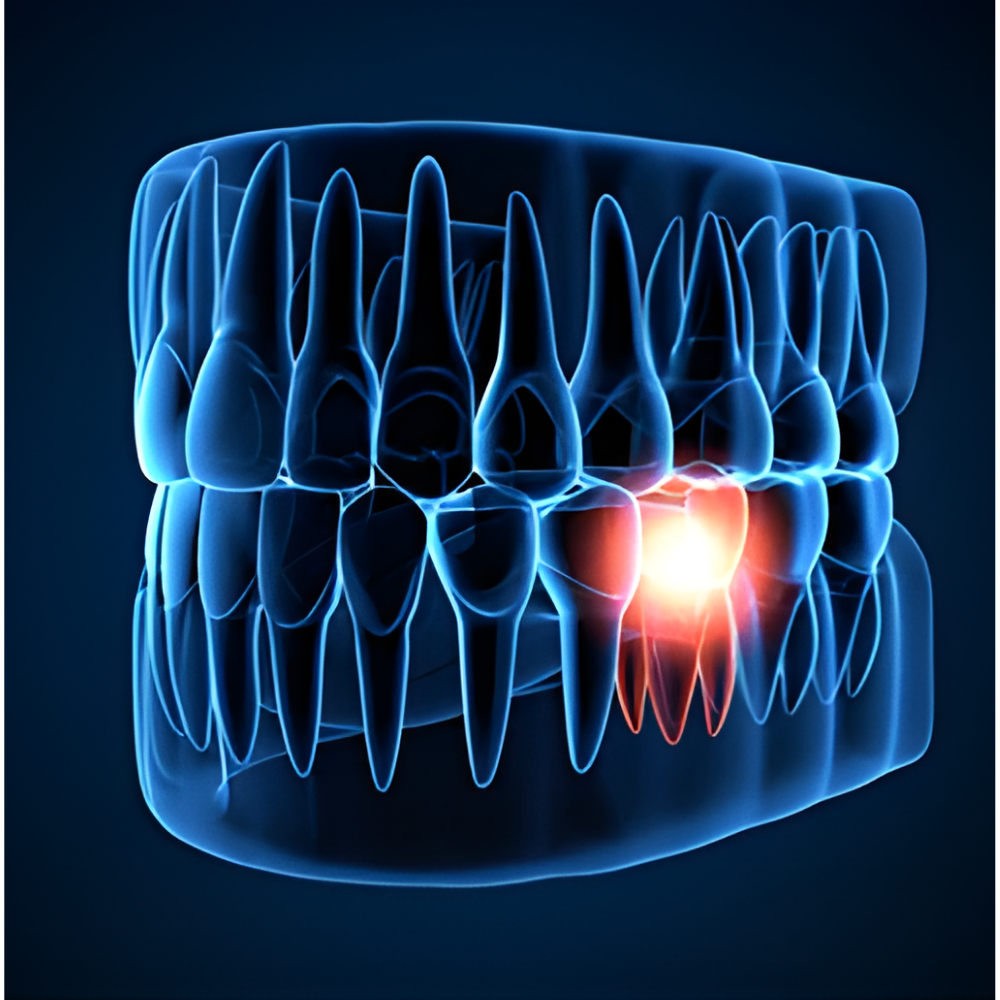
Dental X-ray (OPG)
What is Dental X-ray (OPG)?
A dentist usually recommends two types of X-rays. One is the periapical X-ray, which is small in size and typically captures images of two or three teeth. The other is the OPG (Orthopantomogram), a larger X-ray that captures the image of all the teeth in the mouth. It also shows if there are any tumors or other issues in the surrounding bone. This is a basic introduction to dental X-rays.
- Imagine you have a tooth or two that feels sensitive or painful, but you see no visible problem in the mirror. When you visit your dentist, they will suggest an X-ray. This X-ray will reveal the problem inside the tooth causing pain or sensitivity, which cannot be seen from the outside.
- Suppose your child needs a tooth extraction. The tooth may be slightly loose but not ready to be pulled out easily. In this case, an X-ray is necessary because the tooth is a baby tooth, and the permanent tooth is developing underneath. If the permanent tooth does not form for some reason and you remove the baby tooth, the space may remain empty for life. Moreover, neighboring teeth will shift towards the empty space, causing misalignment in the entire mouth. Fixing this could be expensive and regrettable. A simple X-ray costing only 100-200 Taka could have prevented this problem.
- If pus is coming from a tooth or there is significant swelling in the gums despite regular brushing, the dentist will suggest an X-ray. The X-ray will help determine whether the swelling is due to an abscess, cyst, tumor, or other reasons. Ignoring the swelling without an X-ray might lead to complicated surgery where part of the jaw may need removal. The simple solution was just one X-ray.
- If you are over 25 years old and show no signs of wisdom teeth, an X-ray will reveal the condition of your wisdom teeth.
- If you need a root canal treatment, an X-ray is necessary to see how far the roots extend inside the gums.
- If permanent teeth begin to loosen at a young age, an X-ray can help find the cause.
Actually, the necessity of an X-ray cannot be fully described. It is needed to see what cannot be seen with the naked eye. If you want good treatment, you must help your dentist understand the condition inside and outside your teeth and gums. One of the ways to do this is through dental X-rays.
Now, regarding radiation. X-rays involve radiation. However, modern medicine is aware of the harmful effects of radiation and does not deny the necessity of X-rays. Therefore, continuous research is ongoing to make X-ray machines more advanced so that the intended results can be achieved with minimal radiation. Studies show that exposing a person to more than 50 Gray (a measure of radiation) can cause problems like damage to heart cells, malfunction of nerves, and cellular changes that may lead to cancer. But a dental X-ray emits only about one-eightieth of this radiation. Even this low amount is for a full mouth X-ray or OPG. Periapical X-rays involve even less radiation. Therefore, the chance of physical harm is almost negligible.
However, caution is necessary. Even this small amount of radiation can harm a pregnant woman’s unborn child. So, be sure to inform your dentist if you are pregnant. If an X-ray is absolutely necessary during pregnancy, covering the neck to below the abdomen with a lead apron is essential.
Neglecting dental X-rays is not advisable. Dental X-rays do not expose you to harmful radiation levels and help your dentist understand the health of your teeth and gums. Therefore, take the advice of your dentist seriously and get X-rays done as needed.

Late Suresh Chandra Saha
Founder of J D PATHOLOGICAL LABORATORY CLINIC


J D PATHOLOGY & CT SCAN CENTER
It has earned a strong reputation since its inception by ensuring accurate healthcare services.
| Saturday: 8 AM to 10 PM |
| Sunday: 8 AM to 10 PM |
| Monday: 8 AM to 10 PM |
| Tuesday: 8 AM to 10 PM |
| Wednesday: 8 AM to 10 PM |
| Thursday: 8 AM to 10 PM |
| Fridayday: 7 AM to 10 PM |